Showing posts with label middle age sages. Show all posts

Monday, November 8, 2010

Sri Guru Raghavendra Thirtha

Sri Guru Raghavendra Thirtha was born in 1595 AD in southern India to humble parents, who gave him the name of Venkatanatha as an acknowledgement of their devotion to Lord Venkateswara. As a child Venakatanatha grew up at Kumbakonam under the watchful eyes of his guru Sudheendra Thirtha. As a young man he led normal household life, in poverty, served by his dutiful wife Saraswathim, through whom he had a son. But he continued to serve his guru, whom he succeeded as Swami Raghavendra Thirtha to become the head of the Mutt. Unable to bear the news of his renunciation, his wife said to have committed suicide. As the head of the Mutt, Raghavendra Tirtha performed many miracles and helped many people who became his devotees. During his life time he composed many important Vaishanvite works and propagated the Dwaita philosophy. He died at the age of 78 at Mantralayam, originally known as Manchala, near Adoni, in present day Andhra Pradesh, India. Sri Raghavendra continues to bless his devotees from his Samadhi which is now a famous pilgrimage center in Southern India and known as the Mantralayam temple to which rich and poor alike go to pay their homage.

Link: Web Site1, Web Site2, Web Site3

Swami Samarth

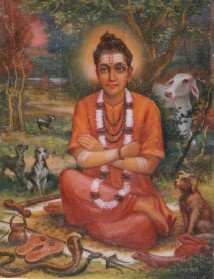
Believed to be an incarnation of Shri Dattatreya the name of this spiritual master, popularly called Swami Samarth, is a household word in Maharashtra and the region around. As this Perfect Master chose to reside at a place called Akkalkot for 22 years where he took Mahasamadhi (left his mortal body) in 1878, he is also known as the Maharaj of Akkalkot, Akkalkot is situated in district Solapur of Maharashtra state of India.

For the devotees of Shri Shirdi Sai Baba, it would be inspiring to learn about the life and deeds of 'Swami Samarth'. A comparative picturisation of the lives of these two great Saints, i.e. Swami Samarth and Shri Sai Baba of Shirdi would establish a surprising amount of commonness in their lives and deeds which includes their methods of teaching, the universality of their approach and the miracles they performed. Even a critical approach by a non-conformist would ultimately lead to the assertion that the over-all role of these two spiritual masters during the second half of the nineteenth century was similar, if not same. One, who is capable of making finer spiritual analysis, would be faced with a bewildering reality. The reality is that Swami Samarth and Shri Shirdi Sai Baba were the manifestations of the same Divine Spirit in two gross bodies.
Link: ShreeSwami.org, SwamiSamarth.com, ShreeSwamiSamarth.com, AkkalkotSwamiSamarth.ord

Sripaad Shri Vallabh

Sripaad Shri Vallabh was born in a Brahmin family in a village named Pithapur (East Godavari District in Andhra Pradesh, India). A Brahmin couple Appala Raju Sharma and Sumathi, were devotees of Lord Datta.They had many children of whom only two survived. One was lame and the other was blind. They worshipped Lord Datta and never failed to offer food to mendicants and monks. They looked uponon all such as they very forms of Lord Datta. One day, they were performing the annual ceremony in their house and many Brahmins were invited as guests for thefeast. Tradition holds that none should eat on that day before these guests partake their food. At that time Lord Dattatreya appeared at their threshold in the form of a renunciate sadhu (saint), bearing the staff and the water-vessel (Kamandalu) and asked for food. The housewife, with immense faith that the visitor was none other than the Lord to whom the whole annual ceremony was being offered, gave Him food even before the Brahmin guests were fed!
Link: Web Page

Sri Narasimha Saraswati

Sripaad Swami told a Brahmin lady to devote her life to the worship of Lord Siva. She did accordingly and, as a result of it, she was born in Karanja a town near Akola (Central India) in a pious family and was named Amba.She grew and she was married to a pious man Madhava Sharma. She was devoted, heart and soul, to the service of of her husband. His noble company added to the holy tendencies she developed as a result of her spiritual discipline in her previous life. She now became an ardent devotee of Lord Shiva.In course of time, she gave birth to a son.The child did not cry, as usual, at birth.On the other hand, the only sound he uttered was 'AUM' (the eternal sound - 'AUM' is the manifestation of the spirit) and everyone was amazed at it. Astrologers assured Madhava Sharma that their child was indeed an avatar of the Lord. They also prophesied that he would renounce all worldly ties and that he would uplit the fallen souls. The child was named Narahari. The name signified that he was the dispeller of the sins and miseries of human beings.

Link: Web Page

Saint Mahatma Shri Basaveshwar

Basava [also known as Basavanna] flourished in the 12th century in Karnataka. He was a Prime Minister to king Bijjala who ruled from 1157 to 1167 over Kalyana, a city of historic importance. Basava was indeed a great prophet for in him we find the combination of rare qualities. He was a mystic by temperament, an idealist by choice, a statesman by profession, a man of letters by taste, a humanist by sympathy and a social reformer by conviction.

Basava strove hard to bring about reformation in Hinduism into which social evils had crept in. The social and cultural conflicts which had been going on in India from ancient days were stimulating a new foment within the Hindu society. At the time of Basava there were apologists who had been giving a new interpretation to the irrational religious practices and form of thought. But Basava with a courageous frankness acknowledged the prevailing evils of the Hindu society and suggested ways and means to create a new orientation.
Link: Web Page1, Web Page2,

Allama Prabhu or Prabhudevaru

Prabhu, who is otherwise known as Allama, Allaya, Allama Prabhu or Prabhudevaru, was probably born in the very beginning of the 12th century. The exact date of his birth is neither known nor has it been ascertained by any of his biographers. His biographers can be divided into two groups: one holding all too human and the other all too divine view of him. Both views are wrong, for both lack the historical perspective and predominantly represent a mythological view. Yet out of this legendary outlook we can glean a few historical facts. Prabhu was undoubtedly born of the human parents at Ballegavi, a village near Banavasi. His father's name was Nirahankara and his mother's, Sujnani. Karavura seems to be his family name. Ballegavi was set in the midst of palm trees, water-pools and rice fields. The temple of Goggeshwara or Guheshwara adorned this inspiring setting. His parents were a devout couple and Goggeshwara was their family deity. Sujnani had often visitations from God, Goggeshwara, in her dreams. Nirahankara was the head of a dance school and was well versed in three branches of music. But a secret longing was gnawing at their hearts. It was the longing for a child. In her daily prayers, Sujnani appealed to God to bless her with a child. One day she dreamt that she had been possessed by God. In the temple opposite her house the image of Shiva quickened to life under her own eyes. A ray of light penetrated to the depth of her being. In the course time, she conceived and gave birth to a child. The child, whom the world was to know as the Vairagya Chakravarti (the supreme renunciate) was named Prabhu. He was a little boy full of fun and life. Nobody imagined what giddy heights, what tremendous depths lay hidden in the little body of this charming child. His artistic temperament and prowess were revealed when he was only six years old. He had inherited from his father's artistic temperament. A passionate instinct for the beautiful was the first channel which brought him in contact with God. But there was a rich undercurrent of asceticism which occasionally peeped through his demeanour. The mutually conflicting instincts for the artistic and the ascetic and for the beautiful and sublime struggled within him for supremacy. In the end, the ascetic instinct got the upper hand and turned him into a renowned 'renunciate'.

Link: Web Page

Bhagavan Bahubali

Bahubali is a great name in the Jain legends. His story is an example of the inner strength of the entire culture of India. He won everything from his brother and could have become an emperor; and yet, in utter selflessness he returned everything to the brother. Bahubali is the ideal man who conquers selfishness, jealousy, pride and anger. This is his story, the story of a great soul.

Bahubali defeated his elder brother who was puffed up with pride, but at that very moment understood his life's aim. He gave back the kingdom to his defeated brother and went away to meditate on God. He enriched the lives of his fellowmen with the light he received. The magnificent figure of Gommateshwara at Shravanabelagola in Karnataka State is that of Bahubali

Link: Web Page

Sakhubai

Sakhubai, a devotee of Panduranga Vittala. Though suffering hardships from a cruel mother- in- law and a foolish husband, She bore it and reposed pure 'Bhakti'(devotion) in Lord Vittala whom, for her sake, served her people and transformed them. Devotee of Panduranga Vittala. Though suffering hardships from a cruel mother- in- law and a foolish husband, She bore it and reposed pure 'Bhakti'(devotion) in Lord Vittala whom, for her sake, served her people and transformed them.

A poor man and his wife lived in a town near Pandharapur. Though poor, they were lead- ing a peaceful, contented life. They would, within their limitations, make dona- tions to charities; they would welcome and entertain guests.They were partaking in others' joys and helping those in difficulties. They were liked by all.

Pandharapur is a holy place. Panduranga Vittala is the presiding deity there. There were a large number of devotees in that vicinity worshipping Him. The poor couples too were among them. They had no children and it distressed them. They ardently wor- shipped Vittala daily and prayed for getting children. As though in response to their devout prayers, the poor man's wife gave birth to a female child. The baby grew up into a beautiful girl possessing many good qualities since childhood. Sakhu had imbibed in her a deep sense of devotion of God. She assisted in the 'Puja' at house by preparing flower-garlands, sandal- wood paste, etc., tended the cattle, assisted her mother with cooking and was constantly engaged in useful domestic chores. The parents loved her immensely.

Neighbors looked upon this smiling, active girl with delight. She would never hurt anybody nor utter harsh words. She made friends with other children and played with them. She respected the elders and was devoted to them. Everybody loved her.
Link: Web Page

Vidyaranya swamy

Vidyaranya great and famous saint who is known as the founder of Karnataka. When people had lost all hope, he provided inspiration to Hakka and Bukka who tilled the people with hope and courage. He adorned the Sharada Peetha of Sringeri. He strove to strong then the foundations of the Empire of Vijayanagar.
Link: Web Page

Sunday, November 7, 2010

Shri Manik Prabhu Maharaj

The great mystic saint and yogi Shri Manik Prabhu Maharaj (1817-1865) is hailed as the fourth incarnation of Lord Dattatreya and has an enormous following in the country. Shri Saibaba of Shirdi, Shri Akkalkot Swami Maharaj and Shri Gondavalekar Maharaj were Shri Prabhu’s contemporaries and they interacted with him on matters of deep spiritual wisdom. Shri Prabhu was also associated with the first war of Indian independence in 1857. All biographers refer to Shri Prabhu as a saint of great spirituality and mysticism. He is hailed as ‘Bhaktakarya Kalpadruma’. Stories of his miracles and eye witness accounts, which bear testimony to the manner in which he brought succor to the distressed and the sorrowing, to the afflicted and the wronged, who, ardently and with deep faith sought his spiritual intervention are available.

Manikprabhu.org

Saint Gora Kumbhar

Though the authentic date of birth of Goroba is not known, still he is traditionally known to have lived in a village named Satyapuri alias Ter. In some places this village has also been mentioned as Terdhoki. No detailed history of the parents and the childhood of Goroba is available; but he was known to be a pious and religious minded man. He no doubt attended to his business of manufacturing earthen pots from mud; but even while attending to his work physically his mind would all the time be meditating on his favourite god Vithoba or Pandurang. He would also be chanting the name of God when his hands would be busy in work.
http://saileelas.org/articles/saints/gora.htm

Sri Vasudevanand Saraswathi

Born in 1854 AD, Sri Vasudeva Shastri, who was later to be known to his followers as Sri Vasudevanand Saraswathi, led an ordinary householder's life before he turned completely to spiritual life. As a householder, he led a rather difficult life, owing to the disputes between his wife and mother. As he turned to spiritual life, he made rapid progress and received direct guidance from Lord Dattatreya. Shri Govind Swami whom he met at Wadi acted as his guide and mentor during these testing times. After his wife's death, he renounced the worldly life completely and went to Ujjain, where he was initiated into monastic life by Shri Narayananand Saraswati, who also gave him the title of Shri Vasudevanand Saraswati. The Swamiji spent the next 23 years of his life in the service of Lord Dattatreya, traveling to various parts of the country by foot and propagating the Vedic ideals

Shri Krishna Saraswati Swami

Shri Krishna Saraswati Swami of Kolhapur was during the period 1836 -1900 AD. Of the various incarnation of Lord Dattatreya that occurred, only this biography is completely available fron Swami's birth to end. Swami is also known widely as Dattaswami , being incarnation of Lord Dattatreya. He stayed at Kolhapur in Kumbhar Lane (Potters Lane) and hence he was called as Kumbhar Swami.
http://www.shri-datta-swami.net/

Brahmarishi Baba Lokenath

We are often inclined to focus on God as the Creator of the Universe and as our personal protector and savior. During every age, however, God also enters human form to embody Perfect Love, Compassion, Humility and Divinity for all humankind. Those manifestations of God in human form inspire and gently remind us that Divinity exists within each of us and that it is both our potential and our destiny to one day attain that same, perfect union with God. The world today is actively blessed by one of God's great Himalayan saints, Brahmarishi Baba Lokenath, who became God in Human Form after 80 years of yogic austerities. Baba Lokenath lived from 1730-1890. Such a life span, though difficult to grasp by the western mind, is not unheard of among great Yogis.

Baba Lokenath, an Embodiment of Love

As an Embodiment of Love, Baba Lokenath promises us, "Whenever you are in danger, whether in war, forest, ocean or jungle, remember Me. I shall save you. You may not know me. You may not realize who I am. Just pray to me with a little touch of your heart and I shall free you from gripping sorrows and miseries." Baba Lokenath calls to us, reaching across the distance of a century, to uplift every dimension of our lives. He reaches out to us with intense love and compassion. He extends an active and intervening hand of grace to heal our ills and personal deficiencies, however large or small, however tenacious they may seem, however hopeless we may feel about them.
http://www.babalokenath.org/

Sant Dariya Saheb

Sant Dariya was born in Vikram era 1691(1634A.D.) on Sunday in Ashwin month at Dharkandha in Rohtas District of Bihar (India).He was brought up and remained at that place for most of his life. It is said that the ancestral place of the Saint is Rajpur which is at a distance of 10 miles from Dhakandha,the maternal place of the Saint.Dharkandha is situated at a distance of about 52 miles from Arrah and about 6 miles from Suryapura.

Sant descended on the scene when the Mughal Empire was on decline and the British were consolidating their feet.There was absence of a powerful central Govenrnment which resulted in termoil in the society.Public was on the whims and mercy of the then local rulers and suffering immensely.Marathas power was on ascendance in the west.There was moral degradation all around and people were looking for a savior. The savior appeared on the scene in Sant Dariya.

Sant Dariya was sent to this world by Anadipurush (Supreme Lord ) to save people from their sorrow and miseries. He presented before the world a path of salvation (Muktipanth).He had to suffer opposition from the orthodox sects at several occasions but he went ahead in his mission with determination. He preached against ritualism and false doctrine prevalent in both Hindu as well as Muslim communities. He preached brotherhood of mankind. He was for unity and harmony amongst Hindus and Muslims.

Sant Dariya got enlightenment at the age of twenty years.When Dariya was one month old , Satpurush visited him and advised his mother to name him Dariya.Satpurush came again to Sant and asked him to preach to the misguided souls to save them. Satpurush assured Dariya that He would meet the basic needs of his followers in this world and ensure their permanent abode in Satlok when they leave their mortal body

Sant Dariya preached non-violence and was against killing of any living being. He was of the view that unless the lamp of kindness(Karuna) is illuminated in the heart, one cannot proceed on the path of realization of God. Sant preached monism . He preached against incarnation theory of God. He said that the Satprush(Anadi-brahm) is beyond triguna and He never comes into the cycle of birth and death.

Saint Dariya was Satguru and only the Satguru knew the path that leads to Nirvan(the state beyond the cycle of birth and death).He called his doctrine as Santmat (Doctrine of the saints).

There are controversies about his ancestory as also birth and death. Scholars are not in unanimity about his dates of birth and death. A brief mention of the Saint is found in Sahabad Report of Francis Buchanan who visited Dharkandha which was then in Sahabad district of Bihar, in 1810 A.D only thirty years after the parinirvan(death) of the saint. No other proven testimony is available about his date of birth. However, no purpose is served in going into controvercies.

The Sabad (word) of the Saint is most important for the welfare of the troubled living beings. Sant preached to one and all, both Hindus and Muslims . People of both the communities became his followers. His words are compiled in nineteen granths (books):

Sant was a poet par-excellence and he composed 15,000 padas (verses). There are altogether 37,000 lines in all these padas. Dr. Dharmendra Brahmachari who published research paper on Sant Daria for his Doctor of Philosophy Degree spoke highly of the poetic genius of the saint.

Sant Dariya, the great saint poet of the medieval India who preached love and human brotherhood breathed his last in Vikram era 1837 (1780A.D) on Friday, the fourth day of Bhado month
Geocities.com/santdariya

Bahinabai

Bahinabai was not just a poetess, she was a devout worshipper of Lord Vithoba of Pandharpur. She was born to Audeo Kulkarni and Jankibai in 1628 A.D. at a town named Deogaon, to the west of Verula, a place well known for its carved temples. Her father, Audeo Kulkarni was a Yajurvedi Brahman and village scribe. A childless couple, Bahinabai was born to them after much penance and austerities. After the birth of Bahinabai, they were also blessed with two sons.

When Bahina was five years old, her parents marry her off to a very learned businessman in Shivpur called Ratnakar Pathak, a widower aged thirty. After Bahina’s marriage, her father Audeo due to family feuds fell into debts and was imprisoned. The son-in-law Ratnakar helped to set him free and the whole family set off to Rahimatpur. After staying there for two years they finally decided to settle in Kolhapur, where they got shelter in the verandah of a learned Brahmin named Bahirambhat. But, of all the places they visited, Bahina liked Pandharpur the best. She was fascinated by the idol of Lord Vithoba and thrilled to hear the Abhangas by Tukaram.

Very soon Bahirambhat received the gift of a cow and a calf which, in response to his dream, he offers to Ratnakar. Bahina and Ratnakar. They take great care of the cow. The calf takes a great liking for Bahina and followed her wherever she went. Once it so happened that Jayaram-swami, a well-known Kirtankar performer of kirtans or devotional musical discourses) had come to Kolhapur. Bahina attended the kirtans with her family, and as usual, the calf followed her to the kirtan. Jayaram Swami noticed this and appreciated the bond between the calf and Bahina, but the people around thought that the calf had strayed into the pandal and drove it out. Noticing this, Jayaram Swami called the calf back and patted both the calf and Bahina. Some people around at the time of the incident don’t take kindly to the Swami’s chidings, and complain to Bahina’s husband, Ratnakar, does not approve of the attention shown by Swami on Bahina and beat her severely. The calf unable to bear the ill-treatment meted to Bahina, gives up eating thus giving up her life.

Grief-stricken, Bahina falls unconscious for three days on hearing about the calf’s death. On regaining consciousness, she finds herself surrounded by her family, but Bahina was a changed person. She had experienced enlightenment in her unconscious state and had seen Lord Vithal before her. She had also seen Sant Tukaram. She becomes a devotee of Lord Vithal and spents her time singing Tukaram’s abhangas. On hearing this, Jayaram Swami tells Ratnakar that his wife Bahina was no ordinary woman but a saint and Yoga-brastha (a former yogi under a temporary lapse) and that he was very fortunate in having her as a wife.

The fame of Bahina’s devotional music spread far and wide, but Ratnakar consumed by jealousy, decides to leave her. On hearing this, Bahina was determined to give up her life in case he did leave her. And strangely enough, before leaving the house Ratnakar was taken suddenly ill and was in great agony. Bahina nursed him patiently day and night which made Ratnakar realize his mistakes, more so since he had abused not just another mortal, but a saint. After Ratnakar recovers his health, the whole family shifts to Dehu. In Dehu, they wanted to shift to locality of Mumbaji, but were refused admission because he was against them, being devotees of Tukaram, who was of a low caste. But this time Ratnakar stood by his wife and she came to be respected even more. They were given a place to stay in the temple of Tukaram. Here they regularly listened to Tukaram’s abhangas and kirtans, and Bahinabai thought herself most fortunate because she could hear Tukaram’s Abhangas day and night. Since then Ratnakar also became a devotee of Tukaram.

The couple Bahinabai and Ratnakar lived quite happily in the premises of the temple but Mumbaji could not bear to see their happiness. Once he drags their cow, ties it in his house and thrashes it severely which the people around can’t bear to see, and beat him. However, Bahinabai intervenes in the nick of time and saves Mumbaji, who repents for his wrong doings and becomes a follower of Bahinabai. In Dehu Bahinabai gives birth to a daughter, Kashi and son, Vithoba, who becomes a great poet and kirtankar like her in the future.

One day, in the absence of her husband, Bahinabai goes to pilgrim quarters and meditates continuously for three days. At the end of the meditation, she felt as though Tukaram himself had placed his hand on her head, blessed her and asked her to compose. It was a transcendental event for her. Overjoyed, she went to bathe in the river and as she came out, words flowed from her mouth. With the blessings of Tukoba, she got full inspiration to compose devotional songs. She began composing abhangas on spiritual subjects.

In many of her abhangas she has expressed on how she attained knowledge of Advaita Vedanta. She lived till 72 years. In her verses, her last message to her son gives description of her previous thirteen births and it is said she knew beforehand the time of her death. It is surmised that she had initiated disciples too. Deenakavi, the author of Panchkaran Mahavakya, was one of her disciples. A collection of her abhangas, songs and poems has been published in a book form by Shri Umarkhani. Bahinabai has specifically acknowledged Tukaram as her Guru and that he initiated her has been clearly expressed in all her Abhangas.
http://www.spiritual-note.com/Bahinabai
http://www.dabase.net/bahinaba.htm

Sant ChokhaMela

Chokhamela lived in Mangalavedha near Pandharpur in Maharashtra in the 14th century. He was born in the lower cast (Mahar), but his devotion to Lord Vitthala was pure and unmatched. He migrated to Pandharpur and became a desciple of the great saint-poet Namdev. Chokha used to constantly chant the name of Panduranga and clean the temple premises daily. However, he was not allowed to enter the sanctum sanctorum due to his birth in the lower cast. One day someone questioned the futility of his devotion to Lord, as he would never be able to see God. Humiliated and deeply hurt Chokha abstained from taking food and wept inconsolably when Panduranga appeared before him, embraced him, took him inside the temple and talked to him. The temple priest was outraged as he felt that the temple was desecreted by Chokha and ordered him to stay across the river Chandrabhaga. Chokha's pleas fell on the deaf ears and at last Chokha went to stay across the river. However, Lord started to visit Chokha daily and both of them used to take lunch together. One day the priest was passing by Chokha's hut when Chokha was taking lunch with Panduranga and Soyara (Chokha's wife) was serving. Priest could not see Panduranga as his mind was impure. Soyara spilled the curd on Panduranga's pitambar by mistake. Chokha exclaimed, "Oh! Soyara you have soiled Panduranga's pitambar". Priest felt it was a deliberate attempt by Chokha to show his devotion and slapped Chokha across his face. Later he bathed in the river and ferried across the river. The priest was stunned to see Lord Vitthala's swollen cheek. He realised the intensity of Chokha's devotion towards Lord. He to Chokha, asked for his forgiveness and requested him to pacify the Lord. Chokha's prayers and request pacified Lord Vitthala.

Chokha was forced to return to Mangalavedha as the people there wanted to construct a wall in order to separate shudra people from others. While he was working there, he was killed when the wall collapsed and was crushed. Namdev deeply grieved the death of a great Vaishnava devotee, went to Mangalavedha and brought the mortal remains to Chokha and constructed his Samadhi in Pandharpur.
http://www.spiritual-note.com/Sant_Chokhamela

Saturday, November 6, 2010

Sant Gulabrao Maharaj

Sant Gulabrao Maharaj was known as Pradnyachakshu Madhuradwaitacharya Gulabrao Maharaj. He was called Pradnyachakshu because he became blind of both the eyes at the age of about 9 months; still he was master of Vedanta philosophy and many occult and physical sciences. ‘Padnya’ means intelligence and eyes are called “chakshu” in Sanskrit language. He had many divine powers which included the ‘intellectual eyesight’. His mind could read and grasp any book in the world in any language that he would take in hand and decide to learn. His mind did not need the body-organ like ‘eye’ to see the world.

“Madhuradwait” was the new school of thought introduced by him. The people well versed in Vedanta know that ‘adwaita’ (non-dualism) philosophy of Vedanta do not accept any name and form visible or non-visible that could be different from God (soul, Atma or Brahma). Vedanta very explicitly proclaims, “When everything has become one-soul, where is any other thing to smell ? who will see whom ? who will listen to whom ? who will talk to whom ? where is any other thing to think about ? who will know whom ? How to know him who knows everything ?” (Asy sarva atmaivabhuta, tat ken kam jighnet ? , tat ken kam pashyet ?.. ……… brihadaranyaka). “What exists is only one thing i.e. Brahma and what we see and experience as world is illusionary” is the teachings of “adwaita”. Madhura Bhakti is the devotional love for lord Krishna. In Vedanta all the three words viz. devotee, devotion and deity are not different from each other where as in Madhura Bhakti one has to be a deity and other a devotee.

Adwaita do not recognize Bhakti at all. Probably the great saint who possessed the eternal knowledge since childhood by dint of providence due to his past karma, had advocated Madhurabhakti for the “after-attaining-knowledge” stage to his disciple.

His full name was Gulab Gundoji Mohod. He was born on July 6, 1881 in a small village named Madhan in Amravati district in Maharashtra and died merely at the age of 34 i.e. in the year 1915. Though he had lost his eyesight at the early age, he wrote about 133 books on various subjects containing more than 6000 pages, 130 commentaries and about 25,000 stanza in poetry. His mother died in the year 1885 when he was four years old. He then stayed at the house of his maternal grand mother at the place known as Loni Takli for about 6 years. In this period people came to know about his extra ordinary intelligence and his “brain-sight” though he had lost his eye-sight. There was a community well in front of the house where he stayed and the women from the village would come to well for water. Small Gulab would call them all by their names, and the women would be wonderstruck and would think as to how the blind boy came to know about their individual names ? He was found many times in deep samadhi stage in the night. Initially his grand mother and others were frightened to see Gulabrao sitting in Yoga position with is respiration stopped completely. However, some elderly and wise men understood the conditions of Gulabrao and asked his relatives to refrain from disturbing him during samadhi. He very much liked the holy songs(Bhajans), holy verses (Slokas) and reading the occult books. He would ask his friends to read the books and would repeat the contents immediately as was heard by him. He had extra ordinary memory. He knew all the Vedas and Shastras at the age of ten years.

He was married to Mankarnika, daughter of Ganaji Bhuyar a farmer in nearby village in the year 1896. He started writing essays and poetry on the religious philosophy since 1897. i.e. from his age of sixteen. Since then he would visit the nearby cities, villages and towns and meet the people to discuss on the various topics of religion. This is incredible but true that in the year 1901 the great saint of 12th century Sant Dnyneshwar Maharaj met Gulabrao and accepted him as his disciple.

Sant Gulabrao Maharaj would call himself to be a daughter of Sant Dnyneshwara and wife of Lord Krishna. He married to lord Krishna in the year 1905. He used to put on the dress and the ornaments like woman. He would lay kumkum ( a red spot) on his forehead and put on managalsutra ( a golden chain with black beads) around his neck which are usually worn by the Hindu married women.

In the year 1902 when he was 21, he wrote the commentary on the theories of Darwin and Spencer. He had written books on various subjects like dhnyan, yoga and bhakti and written commentaries on ancient treatises. He wrote on the “Manas Ayurveda”, i.e. psychological part in the Ayurveda. He had given valuable guidelines to those who want to attain the salvation and gain the eternal knowledge. It is beyond one’s imagination that a blind man could write on the subjects like Yoga, Upanishads and Brahmasutras and many occult sciences which are difficult subjects to understand even by the highly educated and intelligent persons. When he found time to study these sciences ? How he received old treatises and from whom ? Who explained him the secret meanings of the Sanskrit verses ? Many questions like these arise in the mind when one reads his biography and the books written by him. His style of writing is of his own and he has put forth his own views absolutely keeping the Vedic discipline. He has boldly revealed many secrets of the Hindu religious sciences which are not generally made public by the saints.

Though belonged to Sudra class (Kunabi Caste) most of his disciples were Brahmin Pundits. He was openly telling people that he had no right to study the Vedas according to old traditions, but he knew Vedas without studying them and since he knew the “Atmadhnyan” (knowledge of self-realization) he was not bound by many old rules. He used to respect Vedas, Brahmins and the guidance received from great wealth of old Indian religious treatises.

He was straight forward and would defeat many Pundits and Intelligent people in the debate on the Shastras (sciences).

It is generally found in India that the great persons who really had lived only for the cause of welfare of mankind were truly recognized by the people after their death only. Samartha Satguru Padnychakshu Madhuradwaitacharya Saint Gulabrao Maharaj is becoming more and more popular after his Samadhi on 20th September 1915. His many disciples attained the knowledge of self-realization and are known in the public as the great saints. His main disciple, Baba Maharaj Pundit (death 1964) who wrote many books was recognized as a great intellectual, and saint. His commentary on “Bhavartha Deepika” written by Dnyaneshwara Maharaj is published by Geeta Press, Gorakhpur.

The great saints like Gulabrao Maharaj guide the people even after their death by volumes of knowledge written by them.
Web Page [Sugway.com]

Saint Maniram Baba

It is very difficult to write anything about the Great Saint Maniram Baba. “Yatra wacha nivartante buddhen manasa saha” One's mind, intelligence and the power of speech is impossible to reach to the stage where ‘Atmadnyani’ saints could be described.

Why all great saints would visit Maniram Baba’s place is a difficult to understand for we ordinary lay men. The great saint Shri Gajanan Maharaj of Shegaon, siddha purush of Jodmoha saint Khateshwar Maharaj and so many other saints visited Baggi to meet Maniram Maharaj. Baggi is the place in Chandur Railway Taluka in Amravati district of Maharashtra State. Sant Maniram Baba entered samadhi in the year 1915, however, nothing is known about his birth and the place. It was guessed by the people that he was Kanya Kubja Brahmin of Uttar Pradesh. Why he chose Baggi to be his place for living is unknown. He entered Baggi and asked for a room for living. One Ramji was enough fortunate that he could provide accommodation to Sant Maniram Maharaj. Ramji became ardent devotee of maharaj and he then became saint himself after the anugrah (reward) from maharaj.

After coming to Baggi he worked with a rich man as a servant keeping his cows. However, soon the rich man came to know that Maniram was not an ordinary man.

Once so happened that somebody reported to rich man that Maniram do not care for the cows and let them graze; he sits below a tree reading a holy book. Rich man got annoyed and caught Maniram red handed reading the book. He thrown the book in to nearby stream full of water.
Maniram rushed and brought the book from the river. Surprizingly there was not even a drop of water attached to book and the book was not wet at all. This opened the eyes of rich man and in place of employer, he became the devotee of maharaj.

Maniram would stay in the river water for days to gather without food. Many insects and fishes would literally eat his flesh but he was not aware. He look at the Sun from morning till evening without taking away eye from the Sun. Many people have found him many times in Khand Yoga, i.e. he looked to be divided into pieces. Many such yoga ordeals are described in the biography.
The present author has confirmed these fact from his own Guru who was contemporary.

People saw him at many places at the same time. He was a miraculous saint. He cured many people from the diseases like leprosy, he solved the family problems of many people. People saw him reviving the dead animals like dog.

Shri Sant Gadge Baba

Shri Sant Gadge Baba was the great hero of 19th century and known for his social services. He was a holy saint who worked for helpless and poor.

On 23rd of February 1876, Gadge Baba was born in a washerman's family of small village Shengaon of district Amravati, Maharashtra, India. He lived a life of poverty. In starting days of his life he worked in his own field, when he lost his own land he worked as a wage labor. One day he was at a field and keeping birds away from grain. A sadhu who passes near by him, asked Gadge baba ‘if he is the owner of the grains?’ This question turned Baba for realization.

After this comment of sadhu Gadge Baba knows the value of community-sharing and keeps it for his whole life time. Community-service become the base of his teachings of Baba. His teachings were-

Give food to the hungry
Give shelter to the needy
Protect the environment
A public teacher, the Gadge Baba traveled from one place to another place wearing his food pan upturned on his head and carrying his trademark broom. When he entered a village, instantly start cleaning the gutters and roads of village. He also told the citizens of village that their congratulations would have to wait until his work was done. For this job, the peoples of village gave money to Baba. From this money Gadge Baba build educational institutions, dharmasalas, hospitals and animal shelters. He conducted his discourses in form of "Kirtans"(a form of discourse which includes devotional songs by Saints). In which he would emphasis on topics like service to humanity, compassion. During his kirtans he would educate people against blind faiths and rituals. He would use Dohas (couplets of a song) by Saint Kabir in his discourses. Currently almost all organizations build by him are functioning well. On December 20th, 1956 the Great Saint left this mortal world. Even so many years have passed since his departure there is lot of following for him. Government of Maharashtra state also runs a villge cleanliness programme named after him. University of Amravati was renamed as Sant Gadge Baba university.
A detailed article on Shri Sant Gadge Baba Maharaj is now available at http://www.spiritual-note.com/Sant_Gadge_Baba_Maharaj